All our news

Azmari presents « Samā’ī »

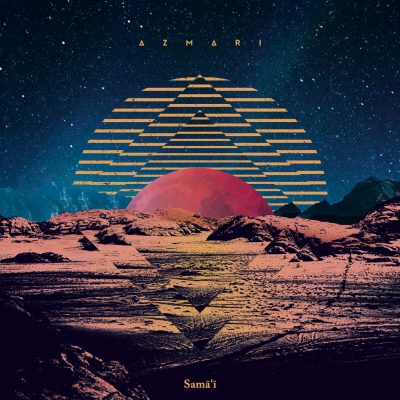
Azmari will unveil their new album "Samā'ī" on its release February 5, 2021 on Sdban Ultra / L’Autre Distribution. « Fat Ari » the first track from this new album was released on November 6, 2020: « Fat Ari means "The creator" in Amharic language, this song evolves from a bewitching theme where both flute and kaval joining in an unique atmosphere to finish with a dub sequence straight out of space... » « Azalai » the second track was released on December 11, 2020, and the band says about it: « Slowly, here she comes. Winding. She rubs her belly against the earth, slaloms between the stones, traces its destiny in the sea of gold. Azalai. The music drags, repeats, completes and flies away like the wind stained with sand and spices. She takes a breath in the desert dunes and walks forward. She walks without respite, she fills herself with images, of flavors, ecstasy and intensifies with the tempo. It jerks, this music. She drowns, exhales and wakes up under the eastern sun. The bodies rock, twist, suffer the bite of the sun and get lost in drunkenness. No one sees the end of it. It’s a hypnotic venom. An endless trance. Always forward. Always towards the distant horizon. We are going forward. Azalai as the only guide. " The word "Azalai" refer to the Tuareg trade caravan which crossed the Sahara desert two times a year for nearly 1000 kilometers for the transport of salt between Taoudenni and Timbuktu. In this epic journey, the band introduces the saz Bağlama and the kaval, two instruments that they brought back during a tour in Istanbul and have then integrated into their universe. These instruments come into communion to take us, thanks to a frenetic rhythm section into an heady trance ... ». I would be happy to send you a copy of the album and any other additional information (visuals, press kit) for announcements and/or interviews. Created in Brussels in 2015, Azmari is a weaving musical odyssey that expertly fuses ethiogroove, dub, psychfunk and eastern sounds. Taking inspiration from artists such as Okay Temiz, Mulatu Astatke, Cymande, Fela Kuti and The Heliocentrics, an Azmari, literally "one who praises" in Amharic, is an Ethiopian singer-musician, comparable to the European bard or the West African griot often accompanied with a masenqo - one-stringed fiddle or krar - lyre, two traditional ethiopian instruments. Having released their debut EP ‘Ekera’ last year, a series of shows across Europe saw the Azmari sound develop and ten days performing in Istanbul opened the band’s ears to the Turkish sounds and rhythms from the 1960s. Keen to get back in the studio to start work on their debut album, studiously studying Turkish and Ethiopian scales, along with learning new instruments along the way including the berimbau, the ney and bağlama, the Azmari sound transformed into a rebellious, unrelenting and mesmerising trip. The resulting nine tracks that make up debut album ‘Samā'ī’, released 5th February via Sdban UItra, is a deeply hypnotic experience where mesmerising rhythms and winding improvisations send the listener in to a higher state of consciousness. From the magical sax of album opener ‘Zegiyitwali’, to the dubby template of ‘Cosmic Masadani’ and joyous horns of ‘Kugler’, Azmari seamlessly blend African and oriental melodies with effortless precision, providing a fresh take on the ethiojazz sound. Elsewhere, the heavy, rhythmic sounds of ‘Tariq Al Sahara’ and the mystical and cosmological ‘Azalai’ continue our sacred journey full of raging saxes and wig-out percussion, while the free-spirited, trippy ‘Kadiköy’ coming in at nine minutes in duration, lends a trance-like quality to proceedings where psychedelic jazz meets afro-funk.
7 December 2020
Aribo Productions presents « Medicine Man Orchestra »

Aribo Productions presents the release of "Medicine Man Orchestra" on January 22, 2021 (Believe Digital Distribution) and on February 5, 2021 (L’Autre Distribution). The Medicine Man Orchestra project was born from the meeting between the Beninese griot Seidou Barassounon and the French producer Mathieu Insa. It is a sensory journey that brings together on stage the percussions of Mélissa Hié (Vol du Boli / Damon Albarn), the electronic machines of Alissa Sylla and the incantations of the griot Seidou. British guitarist Justin Adams (Tinariwen, Robert Plant) and Nigerian percussionist Wura Samba (Keziah Jone, Nneka) also took part in the show soundtrack composed by Alissa Sylla. The scenography is entrusted to Nicolas Ticot (XLR Project) for the creation of light frescoes in three dimensions synchronized to the music. Finally, France Médias Monde, main partner of the project, is providing with RFI Labo, its expertise in binaural* sound mixing as well as the design of virtual reality videos. *Binaural mixing is an innovative technology that allows a 3D sound reproduction as close as possible to natural listening. We will soon announce the date of the Paris premiere soon, by then, here are the dates of the 2020/2021 tour: - November 26: Alliance Française of Accra (Ghana) - November 28: French Institute of Lomé (Togo) + Digital workshop on November 30 - December 5: French Institute of Cotonou (Benin) + Masterclass at Lycée Montaigne on December 4 - January 12-14, 2021: residency & concert at the Forum de Vauréal (Val d’Oise, France) on January 14 evening. - January 22, 2021: Live Stream launching concert at Studio de L’Ermitage (Paris, France) «Medicine Man Orchestra» is an sensory journey through the spiritual worlds of West African griots. It explores the emotional and medicinal power of music and words across borders and throughout history. The griots were born under the empire of Ghana (fourth - thirteenth century), then crossed the history of the empire of Mali (thirteenth - fourteenth century) and the Songhai empire (sixteenth and fifteenth century) and are still present nowadays. Discovering their music is a time-travel challenge: it is to discover a contemporary music of our European Middle Ages which is vibrant, popular, evolutive and «classic» in the noble sense of the term. You still hear it in the village chiefs’ speeches as on the radio or on television. This millennial music, listened to and respected throughout West Africa, has been traditionally invested with a crucial role: the oral transmission of memory, outside religious institutions. Music therapy is used to improve the overall well-being and is particularly beneficial in the accompaniment of people with behavioral, relational or communication difficulties. The therapeutic effect of music has always been recognized. The ancients and traditional cultures regarded it as a sacred science. The griots of West Africa have never doubted the therapeutic effect of their music. Thus, depending on the context, they will sometimes play music to console or comfort at the funeral of a king for example, sometimes to move away from negative energies or to enter a meditative or joyful trance. Therefore, Medicine Man Orchestra is a “traveling therapy troupe” which utilises the principles of music therapy and offers spectators around the world a unique audio and visual experience using innovative sound and image broadcasting technologies. It is an ambitious project whose mission is the appeasement and well-being of its audience worldwide.
23 October 2020

Clément Oury présente “La tête dans la mur”

Sorry, this entry is only available in FR.Clément Oury dévoilera son nouvel album "La tête dans le mur", à l'occasion de sa sortie le 13 novembre 2020 chez Vlad / Inouïe Distribution (digital / vinyle). « Quelques sons du quotidien enregistrés au fil des saisons. Des grains de maïs, des fleurs de houblon, des noix, des pétales de roses et je commence avec cette valse d’Automne. Puis l’envie de partager ces ambiances avec d’autres musiciens à qui je propose ces instrumentations minimalistes, répétitives qui commencent à prendre forme. » Clément Oury. Il ne lui aura pas fallu beaucoup de temps pour accorder son violon : pas de pause ni de soupir pour Clément Oury qui commence son premier couplet dans des conservatoires (ENM de Beauvais puis Conservatoire du Centre de Paris). La ballade se poursuit en crescendo avec la rencontre du tuba dans lequel il s’épanouit deux ans au Conservatoire National de Région de Boulogne-Billancourt dans la classe d’Arnaud Boukhitine, mais aussi en analyse, harmonie, musique de chambre, prise de son et orchestre. Après un an d’auditeur libre au CNSM de Lyon dans la classe de Mell Cubertson, il entre dans la prestigieuse Universitat der Kunste de Berlin dans la classe de Dietrich Unkrodt où il obtient un premier prix. A sa portée, une large gamme de genres musicaux dans lequel il apporte sa touche notamment dans l'Orchestre Philharmonique du département de l’Oise, le projet Shantel & Bucovina Club avec qui il part en tournée européenne pendant 2 ans ou encore dans l'enregistrement de bandes originales dont celle du dernier film de Tony Gatlif. Ce parcours aurait pu se terminer en fanfare, avec Ziveli Orkestar avec qui il joue pendant 10 ans, mais non, le tempo est lancé et Clément Oury se met à accompagner différentes formations : le quatuor Aalma Dili, le groupe Soviet Suprem et depuis peu le projet plus électronique : Mezerg Orkestar. Ce multi-instrumentiste rythme aussi depuis quelques années, tant en enregistrement qu'en concert, les mélodies des jolies voix de The Do, Yael Naïm et depuis peu, Emily Loizeau. La partition était déjà toute écrite et cela va durer jusqu'à ce que l'idée de donner naissance à sa propre musique ne survienne. Clément Oury, après une longue période de réflexion finit par faire appel à sa longue expérience artistique ainsi qu'à son inspiration pour faire émerger un premier album solo reflétant les émotions de la vie.  
23 October 2020

Belkacem Drif présente “Siempre lo mismo” au Studio de L’Ermitage

Belkacem Drif will unveil his new album "Siempre lo mismo" on its release February 5, 2021 on Chez Oime Production / Inouïe Distribution. This new work will be presented live on stage on Wednesday September 15, 2021 at the Studio de L’Ermitage (Paris). Born in the outskirts of Paris, Belkacem Drif is the youngest in a family of 12 children. Though music has always been present in the family, nothing predestined him to become a professional musician. It was with his neighbors, a musical family of gypsy origin, that he learned percussion, discovered flamenco and became passionate about this music. A turbulent boy, he was advised by his teacher to join a music school where he would play classical percussion. At age 16, he started playing at weekend dances and decided to devote himself entirely to music. He enrolled at the conservatory in the 9th arrondissement of Paris, then under the direction of Guy Hayat, he joined the CIM school of jazz, where he studied Jazz harmony with Philippe Baudoin. He graduated from the Emmanuel Bourseault drum school and earned his degree in musicology from University of Paris 8. Belkacem Drif made his early inroads a professional musician accompanying many artists and groups. Rock or Bossanova, Soul or Jazz, Variety in the noble sense of the term, he got a taste of all flavors, nuances, sounds. He remains a lover of rhythm, of rhythms, wherever they might come from. From the music of his original Kabylia to his travels through Spain, Morocco or the United States, his meetings with musicians from all walks of life (Antonio Lopez, Brahim Izri, Julio Laks, Alain Jean-Marie, Saïd Mesnaoui and Travis Bürki, to name a few), Belkacem has maintained his fondness for sharing, for generous music, open to experiences and mixes. In short: openness towards others. SIEMPRE LO MISMO, his 2nd album, opens the door to singing and new encounters. All his compositions speak to this profound fondness for discovery and musical crossbreeding.
23 October 2020

Antonio Placer Sextet invite Antonio Campos et présentent “Trovaores”

Trovaores is the story of how flamenco, jazz and chanson come together in the heart of the snow-capped mountains of Grenoble and Granada. Seven artists overjoyed to come together on stage to create a musical story made up of rules and transgressions, to share it with the public. Their arrangements take us from the most essential flamenco to the sounds of jazz and to the Hispanic or Galician poetic trova, which lend the performance a breath and rhythm, where each beat renders tribute to deep syncretic energy. Trovaores is a show featuring two powerful, contrasting and complementary voices backed up by musicians from various backgrounds, a kind of bridge between the different Souths, halfway between here and elsewhere. As such, it crosses two artistic and poetic universes carried along by deep voices that turn scratchy when the duende calls for it, and showing restraint when emotion is crucial. It is also carried along by the lyrics, which convey a raging forcefulness and devotion at all times. Trovaores is the duende in action and in interactions, because while the duende is the soul of "dark sounds", it is also the spirit of confluence.   Antonio Placer, Vocals and artistic direction Antonio Placer is nominated for the Victoires de la Musique 2022, best male artist category. Singer, musician, poet, composer, arranger, a Galician exiled in France, he creates world music and songs shaped by the different winds that have carried him throughout his career. What is the style, the nature of the music he makes? Hard to classify... He doesn't make flamenco, jazz, fado, tango, or classical music. His art is, first and foremost, the stage that he graces with his generous and engaging presence. He has the sincerity of Jacques Brel, the anger of Léo Ferré and the revolutionary passion of Jean Ferrat. His quivering tragedian performances have been sending up audiences on stages in France and elsewhere for twenty-four years. His words and his presence are moving and hit deep... He has composed over 20 original works on national and international stages in more than 30 countries. In so doing, he has performed over 300 songs to audiences worldwide. He has released 13 albums. His poetry work has been published in several countries and written in four different languages. He has shared his art and composed shows with great artists such as: Fernando Suarez Paz (violinist from Astor Piazolla), Renaud García-Fons, Steve Swallow, Paulo Bellinati, Carlo Rizzo, Elena Ledda, Angélique Ionatos, Amancio Prada, Rocío Marquez, Gabriele Mirabassi, Toninho Ferragutti, Jean-Marie Machado, Stracho Temelkovski, Jean-François Baez, Jorge « Negrito » Trasante, Cristina Azuma, Mauro Palmas, etc.
20 October 2020

Ozferti presents « Solarius Gamma »

OZFERTI: Florian Doucet is a music veteran. Before dedicating to Ozferti entirely, he toured around the globe and in the studio with Afro-Colombian band LA CHIVA GANTIVA (Crammed Discs) and Afro-Portuguese band TERRAKOTA (Fazuma).  He had a call for modern Ethiopian music, and in 2016 released the ADDIS ABOUMBAP EP, 11 tracks of EthioJazz and electronic landscapes. The record received critical acclaim and was widely broadcasted by underground DJ’s and Radios (DJ Mellow / LOW UP, BEAT CHRONIC, Radio Nova Paris) but also on big stations (KCRW Los Angeles, Worldwide FM, RINSE fm France).  This was the beginning of the Ozferti project, an adventure wich would encapsulate Flo’s musical and visual arts skills. The music contains elements of Electronica, Jazz, Hip-hop and Bass music, while using the color and richness of East-African instruments and rythms. It is a space odyssey, depicting the story of a purple planet and a masked musician, a strange place that makes us reflect on our own world.  SOLARIUS GAMMA: Welcome to the first chapter of the OZFERTI saga. Step into an unknown galaxy, where gravity is multi-dimensional and they don’t have Netflix ; where new gods are replacing the old idols and the ecosystems are being crushed by space-mining economy. Follow OZFERTI, the masked beatmaker, in his journey to the stars, in an album inspired by East-African music and partly produced and recorded in Addis Abeba, Ethiopia. The 11 track album takes you through desertic landscapes and sci-fi atmospheres, with traditionnal rythm patterns and percussions being mixed with electronic synthesisers and live electric guitar.
2 October 2020

David Krakauer & Kathleen Tagg présentent “Breath & Hammer”

Sorry, this entry is only available in FR.David Krakauer & KathleenTagg dévoileront leur nouvel album "Breath & Hammer", à l'occasion de sa sortie le 21 août 2020 chez Table Pounding Records / L'Autre Distribution. Le duo est composé de : - David Krakauer : clarinette  - Kathleen Tagg : piano et "piano orchestral"   Le clarinettiste américain David Krakauer, nominé aux Grammy, figure incontournable de la musique klezmer du XXIe siècle, et par ailleurs soliste de Musique Classique, et Kathleen Tagg, compositrice, arrangeuse, pianiste et productrice novatrice, sortent Breath & Hammer sur leur propre label Table Pounding Records, avec une tournée européenne en vue pour promouvoir l'album dont la sortie est prévue en France le 21/08/2020 chez L’Autre Distribution. Cet album, véritable performance électro-acoustique révélant les approches innovantes et idiosyncrasiques du duo sur leurs instruments respectifs, présente à la fois des compositions originales et des interprétations très personnelles de la musique de certains de leurs amis les plus proches, parmi lesquels John Zorn et Kinan Azmeh, dans une texture qui intègre de manière transparente des boucles, des samples et des performances en direct. Breath & Hammer est à la confluence de plusieurs courants musicaux, résultant des solides références des deux artistes en tant que musiciens de concert classiques, mais aussi des années de Krakauer en tant qu'innovateur klezmer, compositeur, leader de groupe et expérimentateur d'avant-garde, ainsi que de la carrière à multiples facettes de Tagg, qui a créé et joué pour la scène et le théâtre, allié à ses compétences en tant qu’arrangeur et productrice Le Wall Street Journal déclare que "David Krakauer est un clarinettiste tellement expressif qui passe si facilement d'un genre à l'autre que l'on pourrait presque penser qu'il n'y a pas de différence appréciable entre le jazz, le klezmer et la musique classique formelle", mais la description convient aux deux partenaires et laisse entrevoir le fil conducteur de chaque projet qu'ils entreprennent : favoriser les liens humains par une musique qui transcende toutes les frontières stylistiques et culturelles. Comme pour tous ses précédents albums, Tagg a produit Breath & Hammer, que Krakauer décrit comme "une tapisserie médiévale de la taille d'un appartement, composée d'échantillons de la taille des ongles". Parmi les compositeurs qui ont contribué au projet, on trouve le saxophoniste John Zorn, le clarinettiste syrien Kinan Azmeh, le percussionniste cubain Roberto Rodriguez, l'accordéoniste Rob Curto et l'accordéoniste et spécialiste du klezmer Emil Kroitor, en plus de Krakauer et Tagg eux-mêmes. Lors des performances en direct, les techniques de jeu étendues, les boucles et les samples de Breath & Hammer sont galvanisés par un flux vidéo immersif à plusieurs caméras créé par l'artiste vidéo Jesse Gilbert, basé à Los Angeles, permettant au public de voir de près et en temps réel les styles de jeu peu orthodoxes du duo. Une conception vidéo considérablement élargie, projetée sur un hexagone translucide de grilles entourant les artistes, a été créée à la Pierre Boulez Saal à Berlin et a été présentée en avant-première avec des intermèdes sonores spatialisés nouvellement composés au printemps dernier sous le nom de Breath & Hammer II : Les liens qui nous unissent.
10 June 2020

Niqolah Seeva présente “3NE”

Sorry, this entry is only available in FR.Niqolah Seeva dévoilera son nouvel album "3NE", à l'occasion de sa sortie le 23 octobre 2020 chez Vlad / Absilone / Socadisc / Believe.Ce nouvel opus sera présenté le mardi 20 octobre 2020 à 20h30 sur la scène du Studio de l'Ermitage. Instrument hybride, langue hybride #Anglarabe, thématique futuriste, harmonie microtonale, instruments orientaux et traitements electro- acoustiques, "3NE" (prononcer “One”) symbolise l'unité dans la multitude.   Musicien explorateur aux inspirations multiples, Niqolah Seeva est constamment en quête d'expériences sonores et de nouvelles vibrations. Avec son instrument inventé en bandoulière (croisement entre un oud et une guitare), il s'est progressivement affranchi de toute forme de contrainte artistique, dans un inexorable exode qui l'a mené du rock'n'roll de ses débuts jusqu'à des territoires aussi divers que le Maghreb, le Moyen-Orient ou encore l'Inde. Toujours en quête de normes à recréer, l'auteur-compositeur est allé jusqu'à inventer une langue, là aussi hybride entre Orient et Occident (mélange d'anglais et d'arabe), pour décrire un univers fantasmé, comme un idéal de confraternité universelle, mais aussi comme un refuge, à bonne distance des pièges qui menacent habituellement le parcours d'un artiste indépendant dans une exploration des musiques du monde. Niqolah est un musicien que la soif d'aventures sonores n'a pas noyé dans des approximations ou des compromissions. En plaçant durablement sa création dans le champ du rêve, il donne à voir un univers singulier et intime, fait à la fois de son histoire personnelle et d'influences voyageuses. Ces influences, il les intègre dans une démarche systématique originale, plus proche de celle d'un peintre que de celle d'un photographe – observant la diversité des hommes sans jamais les traiter comme des objets de curiosité, mais bien comme des pairs.
29 May 2020

Amando Risueño presents « El Canto del viento »

Guitarist-singer, Amando Risueño performs the music of Argentina with poetry and depth. He echoes stories from his country, universal stories, while holding at heart the mystery and emotion of music to come and touch every fiber of the listener's body. Born in 1969 in Buenos Aires, Amando started playing guitar around the age of ten. He got swept away by this budding passion and studied classical guitar at his local Carlos Buchardo National Conservatory of Music. In this world of globalized culture, his curiosity brought him to the electric guitar and other genres such as jazz, blues, rock and pop. At around age thirty, he started questioning his cultural identity and relationship with the music of his country. He then ventured out into the musical repertoire of his hometown, the tango, working on well-known pieces while also uncovering some rare gems. In 2011, he settled in France, a new territory that led him to form a strong bond between music and landscape. Since then, he has gone on to explore more traditional repertoires from various regions of Argentina, such as zambas, vidala, chacarera, stilo, and others. His first solo album, "Tangos de mi Flor" (2013) is devoted entirely to tango. He then recorded "Campo abierto" (2018) where the repertoires of Buenos Aires (tango, waltz) gets crossed with those of inland regions (milonga, zamba, vidala). Amando plays concerts in France and abroad. His recordings and live work enjoy regular support from Spedidam, FCM, Adami, Fonpeps and the Drôme Departmental Council. With "El canto del viento", Amando Risueño takes us into the world of Atahualpa Yupanqui, in homage to both the composer and poet as well as the performer. Atahualpa Yupanqui transcended traditional Argentine music to bequeath onto us his timeless work in music and philosophy. Amando approaches it as a delicate game through a succession of melodies that give full measure to these stories about the women and men of the earth. The wind, moon, sun, mountains, valleys, plains, and animals recur throughout. Between two pieces, Amando speaks about evoking the life of the artist and quotes magnificent texts from the book written by Atahualpa in 1965: « El canto del viento ».  
1 April 2020

Sambuca presents ” Luz “

Sambuca is Roberto Stimoli (7-string guitar) and Irene Amata (vocals). The duet plays Brazilian music, and is very active on the Parisian jazz/world music scene.One voice and one seven-string guitar to reinvent the rhythms of the samba: it is the ambitious goal that Roberto and Irene share, united in their passion for this music from a faraway land, that is nonetheless a part of them. In their repertoire, you will find several bossa novas that have been performed by the greatest artists: thus Sambuca chooses to reinterpret them with a fresh, yet authentic sound. The Portuguese language is truly a part of these melodies, and it is Sambuca’s deliberate choice to use the original lyrics, so as to highlight their importance in the rhythm and feel of the music. It isn’t necessary to understand the meaning of the words: it is the sweet yet powerful sound that catches the ear, captures the attention and opens the senses. One voice and one guitar: yet there is nothing missing. The seven-string guitar carries the bass-line, and the voice is full of rhythm. Both musicians improvise in a playful mood of mutual appreciation. One voice and one guitar fill the space, capturing the audience’s attention. Creating a new way of listening to Brazilian music is Sambuca’s challenge and passion. Sambuca’s first album was recorded in Italy in 2019, its title is « Luz » (Portuguese for ‘light’); it will be released in mai 2020 (with a launching concert on May 13th. in Paris). With Luz, Sambuca offers a reinterpretation of 10 songs (8 Brazilian pieces, 1 Italian song and 1 French song). The arrangements are very personal, new and intriguing. Roberto and Irene utterly transform bossa nova classics with their unique vision and interpretation, yet never betray the original harmonies. And when the duet revisits sambas, the dialogue between voice and guitar enhances their beauty —the voice’s timbre and the audacity of the guitar creating an ideal combination. The material in Luz is a mix of world-famous songs (e.g. Garota de Ipanema, Chega de Saudade de A.C.Jobim/V.Moraes) and tunes by others Brazilian composers that audiences are less familiar with (e.g. Luz negra by N. Cavaquinho, Vera Cruz by M. Nascimento). A wide-ranging repertoire, that shows Roberto and Irene’s passion for the rich and vast Brazilian musical heritage. A repertoire the duet usually performs on stage and have now chosen to record. Improvisation is an essential part of this dialogue between voice and guitar, and reflects Sambuca’s distinctive blend of jazz and Brazilian Popular Music (MPB). Two songs on Luz are little tributes. La Javanaise is a tribute to France—Roberto and Irene’s adopted country, where they are building their musical career— and Estate pays hommage to Italy, their homeland.  
24 February 2020

Ariana Vafadari presents ” Anahita “

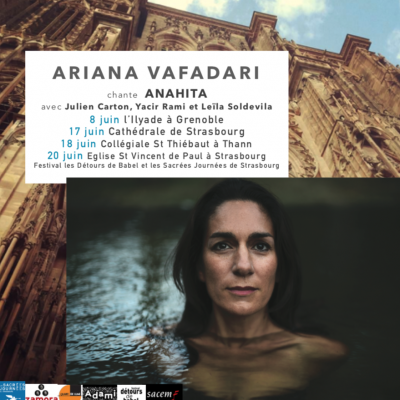
Anahita is the musical opus born of the friendship and artistic collusion and intellectuel of two Franco-Iranian women Ariana Vafadari that composed the music and Leili Anvar that imagined the story and wrote the texts. THE STORY A young women dreams of the time her village was still green, she wakes to see the dying trees and senses her empty belly. She has traversed deserts and lands on fire, in despair, she prays to the goddess with whom she shares the name : Anahita. This divinity of the waters, fertility and wisdom, is the one that dispenses water for all rivers and streams and thus to all peoples. She is the healer and the source of wisdom. It came to pass that the cult of the feminine fell into disuse and her countenance was effaced from human memory, causing the gradual retreat of the waters from the rivers and aquifers. After a mystical exchange with the goddess, the young Anahita departs on a quest for the water of immortality and finds Love. Ariana Vafadari was exposed from an early age to the poetry and philosophy of Zoroastrianism thanks to her father, she has undergone a growing longing to bring back to life the ancient scripts of Zarathustra, as collated in the Avesta, the writings founded on the tenets of wisdom, spirituality and a profound faith in the natural goodness of mankind. Thought these prayers to Anahita, the will of Ariana et Leili is to bring back the place of felinity in the world. Ariana works in the company of a throng of fine musicians from many cultural origins or inclinations — some are masters of traditional Iranian music but others come from backgrounds in jazz, Moroccan music and, indeed western classical music. They journey between spheres with ease. The textes are in persan, french, in avestic language, the ancien language of zoroastriens and in italien.
24 February 2020