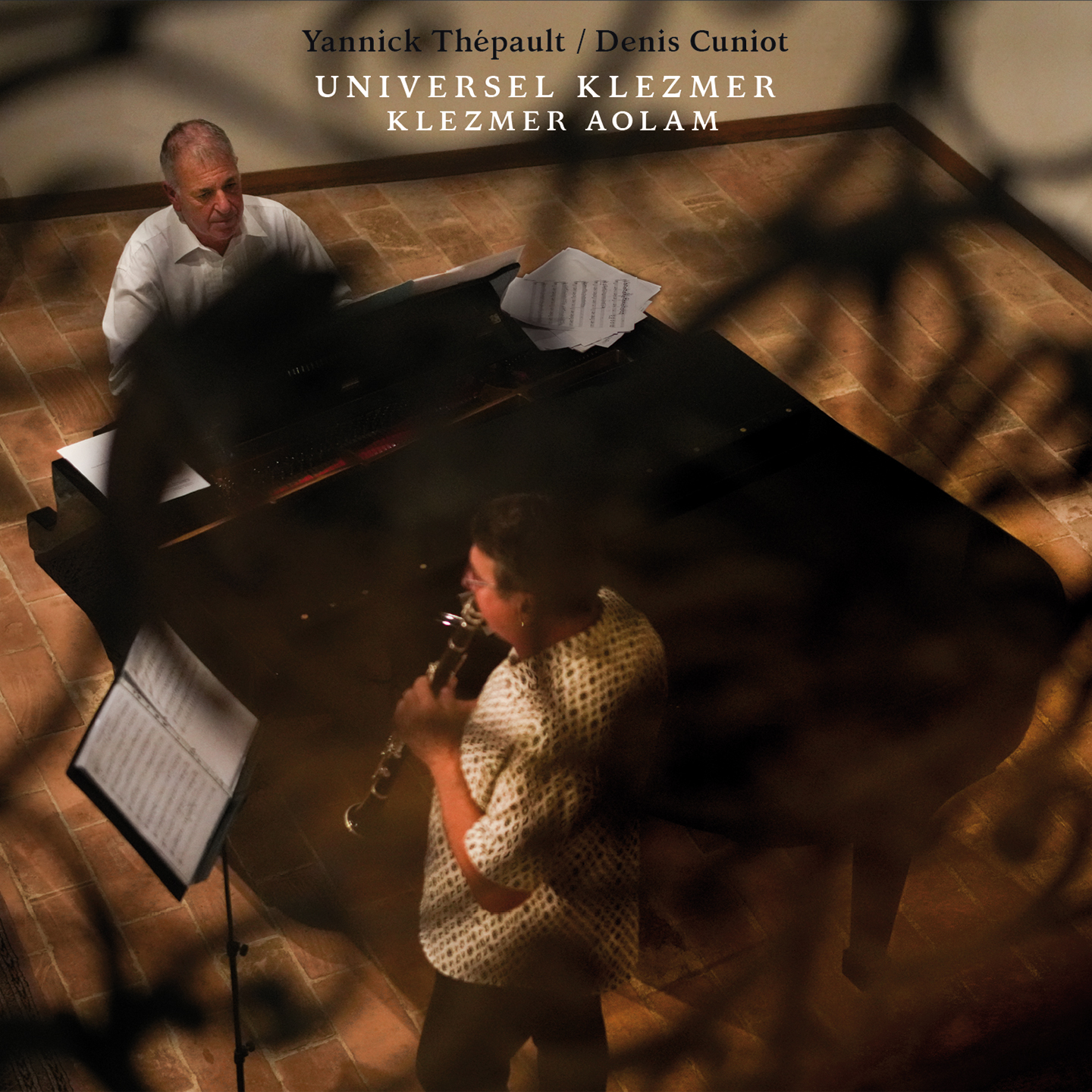
The duo Yannick Thépault (clarinet) & Denis Cuniot (piano) will release their new album, “Universel Klezmer – Klezmer Aolam”, on Friday, November 6, 2026 (CD and digital) on Buda Musique / Socadisc. The album will be presented live during a series of concerts at the Rendez-vous d’Ailleurs (Paris, 20th arrondissement) on Thursday, November 19, Friday, November 20, Saturday, November 21, and Sunday, November 21.
The first single, “Une maman et une tante aux petits soins – Zorgn”, will be available on October 16, 2026 on all platforms.
‘This album was born out of a desire—shared with my friend Denis Cuniot—to perform works by great composers, some of whom were not Jewish, who had adapted traditional Hebrew melodies. The clarinet, with its infinite range of nuances, its wide range, and its timbre that sometimes resembles the human voice, gives the melody a distinct character. We sought to convey the meaning of the lyrics through our musical interpretation. A flower takes shape through its fragrance and our imagination. The interpretation of Hasidic music differs between the United States and Europe. In the U.S., performers emphasize the festive, urban aspect, no doubt influenced by jazz. In Europe, shaped by its history, the mood shifts from laughter to tears. Shostakovich said of Jewish music: “It is an ocean of tears with a burst of laughter in the middle.” The pieces we present are arrangements and free adaptations of the original scores. I have preserved their harmonic and rhythmic foundations and reinterpreted the melodies.’
Yannick Thépault
Album Presentation Universel Klezmer (Klezmer Aolam)
‘Jewish folk music, an expression of a long-standing tradition, transcends all boundaries, starting with those that separate the religious from the festive and classical composition from folk music.
The composer and cellist Joachim Stutschewsky (Ukraine 1891–Israel 1982) set out to demonstrate this, through both music and words. In 1935, he published in Vienna a veritable manifesto of contemporary Jewish music, Mein Weg zur jüdischen Musik (My Path to Jewish Music). Born in the Russian Empire, Stutschewsky emigrated to Germany to study at the Leipzig Conservatory; he worked as an itinerant musician before settling in Vienna, where he worked in the tradition of Arnold Schönberg. After the Anschluss, he went to the Jewish community in Palestine, where he devoted himself to collecting the diverse Jewish musical traditions—Ashkenazi, Sephardic, Persian, and Yemeni. Stutschewsky never ceased to repeat that Klezmer is not a form of light music or folklore, even though it is often played by Schnorers—beggars—which he himself was before his time in Vienna.
The title of this album, Universel Klezmer—universal Jewish music—can be seen as a double pleonasm, since the universal is the very essence of both Judaism and music. The word ‘Klezmer’ does not refer to a genre or a particular tradition; in Yiddish, it simply means ‘musician.’
This universal dimension did not escape Maurice Ravel, who drew inspiration from it in two ways: through the Aramaic sounds of the Kaddish and through those of Yiddish in his arrangements of popular Jewish songs. The most French of composers—whose *Boléro* is to musical heritage what the Eiffel Tower is to Paris—never ceased to draw inspiration from the music of the world. He orchestrated Mussorgsky’s Pictures at an Exhibition and was a champion and friend of Igor Stravinsky. At the height of World War I, he responded sharply to Saint-Saëns, Cortot, and Vincent d’Indy, who were urging the government to ban public performances of contemporary German and Austrian works so as not to have to pay royalties to nationals of enemy countries. ‘It matters little to me that Mr. Schönberg is Austrian,’ wrote Ravel, who considered him the most important of his contemporaries alongside the Russian Stravinsky, and he came to the defense of two citizens of the Habsburg Empire, Bartók and Kodály, who, though Hungarian, were nonetheless immense musicians.
Ravel understood Bartók’s method, which drew on folk music and songs, challenging the principles of classical composition of the Viennese Holy Roman Empire of Harmony. During a tour of the United States in 1928, Ravel spent a few nights in Harlem’s jazz clubs in the company of George Gershwin. Upon his return, he wrote: ‘You Americans take jazz too lightly ( …) it is jazz that will give birth to American national music.’ As universal bridge-builders, Klezmer musicians encountered, on American soil, the descendants of African slaves. Like the singer Al Jolson, many Jewish musicians painted their faces with black shoe polish to join jazz bands. A classical clarinetist who had learned music in a Chicago synagogue, Benny Goodman became, in 1935, the first white man to form a jazz band, whose mixed membership defied racial segregation—then enshrined in the laws of several states and ingrained in the customs of the entire United States. (…)’
Guy Konopnicki